
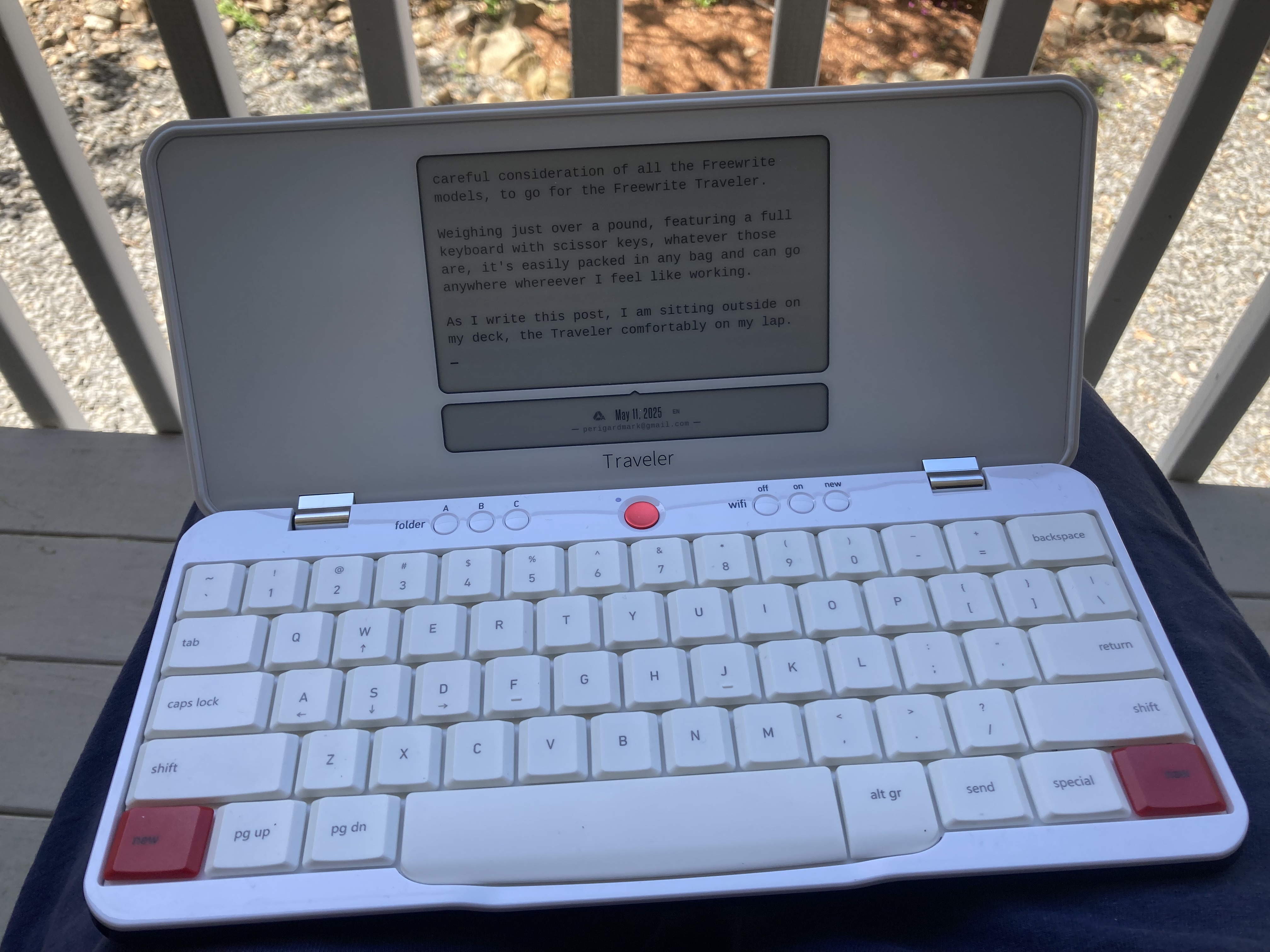
The makers of the Freewrite bill it as a “smart typewriter.”
I see it as a dumb word processor.
But nicknames aside, the device has its allure.
I spent a good month reading and watching everything I could about the Freewrite.
These various models are marketed solely to writers. The hook is that they offer an immersive experience that is hard to find anywhere else because they are built for one thing and one thing only: writing.
Forget the doomscrolling.
You can’t check your Amazon order. You can’t order UberEats. You can’t see who’s having a cute day on Instagram.
No cat videos on Youtube for you.
All you can do is type and inhabit your own worlds of dreams.
The devices impose a discipline that few of us can apparently adhere to.
On Youtube, users talk about losing themselves in their writing.
They’re more productive, more focused, able to dig deeper and drive harder in their work.
If you are considering a Freewrite, the one question you should ask yourself is: What kind of writer are you?
A plotter or a pantser?
A pantser, as the word implies, is someone who writes by the seat of the pants.
I am more of a plotter.
For the novel I am now editing, a historical work set in Revolution-era France, I estimate about sixty percent was plotted, and the other forty percent was pantsed – that is, worked out as I went along.
I like having an outline, no matter how rough, so I hit my plot points and my character beats.
When I worked, I often had my draft open along with my outline/notes document on the screen.
But you can’t refer to one file while working on another on the Freewrite – well, you could swing between two documents, but it’s terribly clunky, and you can’t have them on the screen at the same time.
The Freewrite is for first drafts. This is not a tool for editing. You can certainly backspace, and with the WASD keys, you can move around the page, but this is cumbersome. Freewrite is where you bang out your thoughts and clean up the mess later.
You really are winging it, for better or worse, on the Freewrite, and that is a major selling point for the company and a lot of buyers.
So while I certainly didn’t feel like the ideal Freewrite customer, given how I work, I was still intrigued.
I like to write in libraries or outside, if I can. I often take notes at lectures or off of TV shows or DVDs.
I wanted something portable. I finally pulled the trigger and opted for the Freewrite Traveler.
Weighing in at just over one pound, this beauty features a full-sized keyboard and two screens, one for prose and a smaller one that can cycle through displays of time, the date, your email address, or a timer if you want to set a writing sprint.
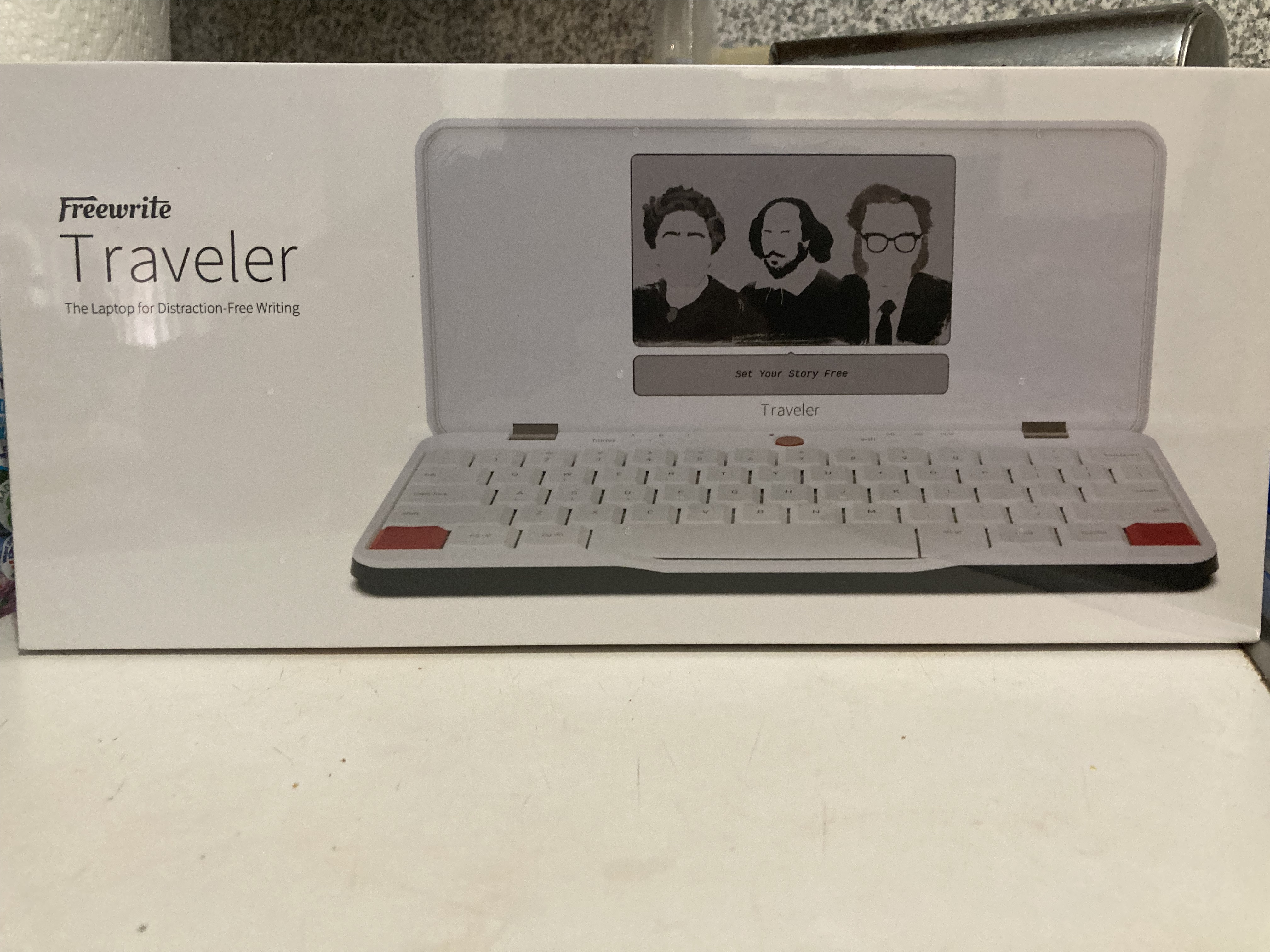
Set-up is a breeze from the box. The lithium battery offers long life. There’s no need to save anything. The device automatically saves every document you create to itself, as well as its own cloud service, Postbox, as well as syncing to whatever cloud service you rely on. Having drafts automatically delivered is a tremendous feature.
With the Traveler, I can work anywhere, on my couch, at the library, outside on my deck, at the beach, all with the keyboard comfortable on my lap. The full keyboard makes typing easy. The Traveler uses something called the scissor-switch keys, which make little noise but feel satisfying as you tap along.
As I write this post, I am sitting outside on my deck, the Traveler comfortably on my lap.
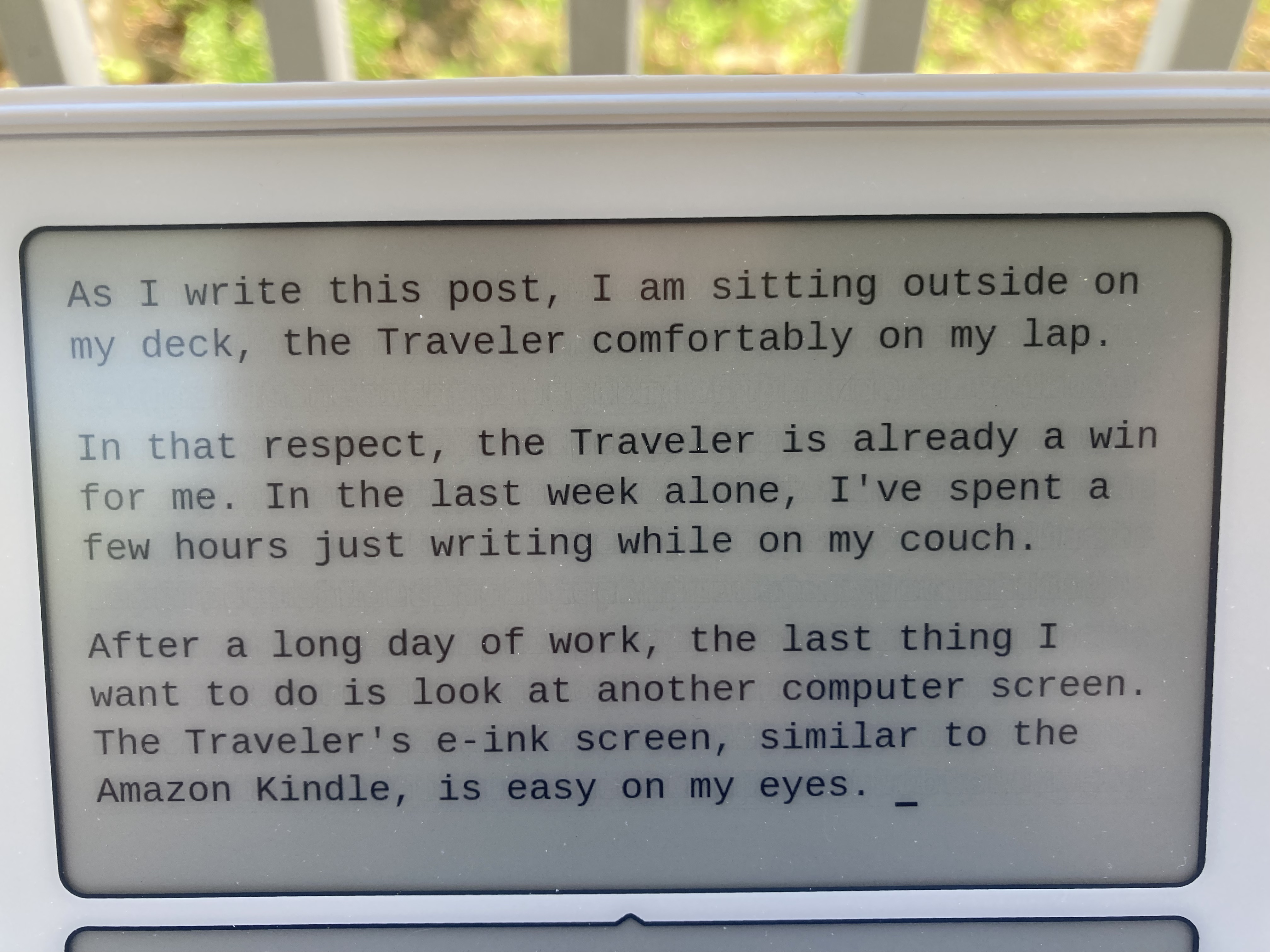
In that respect, the Traveler is already a win for me. In the last week alone, I’ve spent a few hours just writing while on my couch. Drafting this post, diving into a new short story, taking notes on a movie I watched, I discovered the Traveler made everything a breeze.
After a long day of work, the last thing I want to do is look at another computer screen. The Traveler’s e-ink screen, similar to the Amazon Kindle, is easy on my eyes.
I am much more productive with my Traveler, and I can’t wait to see where this takes me.
That said, there are a few cons you must consider before making a purchase.
The lag: The Traveler’s e-ink screen is always about a half-second late posting whatever you are typing. This bothers a few people. I am not one of them. Most people adjust, or like me, simply ignore it. Hey, I’m too busy typing my next glorious masterpiece.
Another con, and it is a big one: The Price.
I ordered my Traveler direct from the manufacturer Astrohaus, and I got a deal at $500.
Amazon currently sells the same model for $550 – that is, when it has the Traveler in stock. It comes and goes. Astrohaus is already warning that it does not how long it can keep down prices because of the ridiculous trade war Mango declared.
The top of the line Freewrite model, the Hemingway, sells for $1,099. The basic LCD backlit model sells for $350.
As much as I am enjoying my Traveler, there’s no denying it costs twice more what it should. There’s no way this model should retail for more than $250.
But like many users, I have already discovered I am more productive with the Freewrite.
I am writing more. It’s a tool, and if it can make your work easier or make you more excited to write, then you might find it well worth your investment.
There are an awful lot of products and services marketed to writers, and most of them play on vanity and hopes and are just ridiculous. That gave me pause with the Freewrite. But I am delighted to report that I enjoy my Freewrite.
But it’s not for everyone.
 Mark Perigard